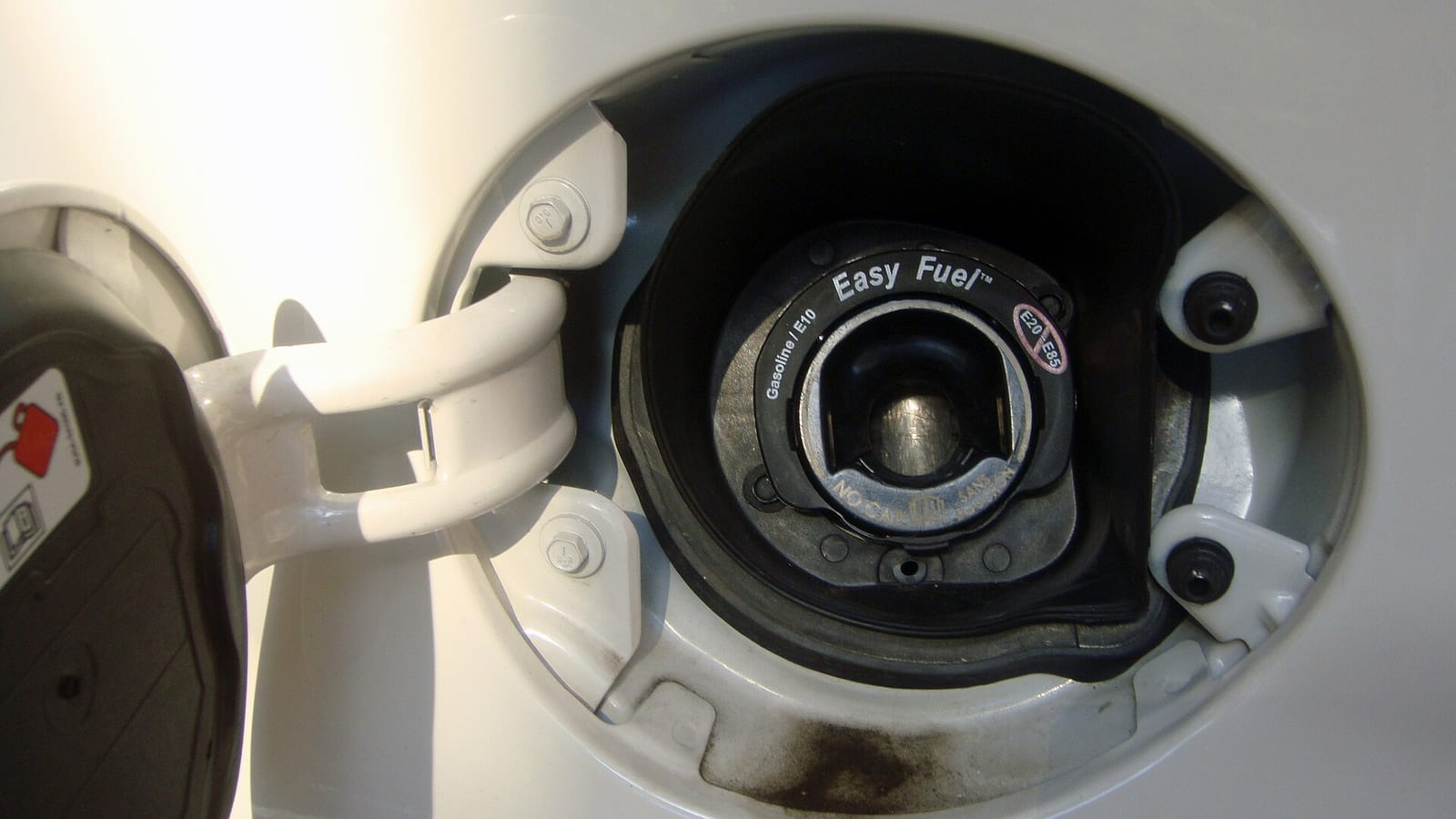
If you have ever hesitated at the pump between the bottle marked E10 and the one marked E5, you are not alone. It is one of the most common questions European drivers ask, and the honest answer is short: for the vast majority of petrol cars, E10 is fine and it is usually cheaper. Here is everything behind that answer.
What E5, E10 and E85 actually mean
The number is the maximum share of bioethanol blended into the petrol:
- E5 contains up to 5% ethanol. It is the older, traditional blend, and in many countries it now survives as the higher-octane "Super Plus" or 98 grade.
- E10 contains up to 10% ethanol. It is the standard "regular" unleaded across most of Europe today.
- E85 contains roughly 60% to 85% ethanol (the share drops in winter for cold starts). It is a specialist fuel for flex-fuel vehicles and cars fitted with an approved conversion kit, and it is widespread only in a few countries, above all France, where it is sold at more than 4,000 stations.
Ethanol is a plant-based alcohol, so a higher blend means lower fossil-CO2 per litre. That is the whole reason Europe has been raising the ethanol share.
Where E10 is standard, and where E5 still rules
E10 is now sold across most of the European Union, in around 19 member states including Germany, France, Belgium, Austria, the Czech Republic, Hungary, Romania, Denmark, Luxembourg and the Nordics.
The clear exception is the Mediterranean south. Spain, Portugal, Italy, Slovenia, Croatia and Greece have largely not rolled out E10, so the standard unleaded there is still an E5 blend. This matters if you are driving south on holiday: the grade names on the pump change as you cross borders, even when the octane rating (usually 95) does not.
To put current prices next to the grade question, here is the live petrol average in a spread of E10 and E5 countries, as of 27 July 2026:
| Country | Gasoline (€/L) |
|---|---|
| 🇩🇪 Germany | 2.17 |
| 🇫🇷 France | 2.04 |
| 🇮🇹 Italy | 2.04 |
| 🇪🇸 Spain | 1.66 |
| 🇵🇹 Portugal | 2.02 |
| 🇸🇮 Slovenia | 1.67 |
| 🇭🇷 Croatia | 1.76 |
| 🇬🇷 Greece | 2.01 |
Live averages in EUR per litre; cheapest in bold. These are averages across the whole petrol category at Petromap's tracked stations, not a per-grade figure, so read them as the general price backdrop rather than an exact E10-minus-E5 number.
Across the EU as a whole, petrol currently averages about 1.90 €/L. In our example markets it runs 2.17 €/L in Germany, 2.04 €/L in France, 2.04 €/L in Italy and 1.66 €/L in Spain. Germany and France sell E10 as standard; Italy and Spain do not.
Can your car run E10?
For most drivers, yes. Industry estimates put roughly 95% of petrol cars on the road in the E10-compatible camp, and as a rule of thumb almost every petrol car built from 2011 onwards was designed for it. The exceptions are older vehicles, some classics, certain motorcycles, and a handful of specific engines where the manufacturer never cleared E10.
The reason to check rather than guess: ethanol is slightly more corrosive and more of a solvent than pure petrol, so in an engine that was never built for it, a 10% blend can attack seals, hoses and older fuel-system parts over time.
Two reliable ways to check:
- Your owner's manual or the fuel-filler flap. Newer cars often state the compatible fuel right there.
- The manufacturer's E10 list. Carmakers and industry bodies publish model-by-model compatibility lists, and some governments host an online checker where you enter your make, model and year. Diesel drivers can ignore all of this: E5 and E10 are petrol grades only.
If your car is not E10-compatible, you simply keep using the E5 grade (see below). You never have to guess between them.
Does E10 actually save money?
Usually, yes, but the saving is smaller than the sticker gap suggests, and here is the honest trade-off.
- Price: E10 is normally the cheaper pump. In Germany, for example, E10 has typically been several cents per litre below E5 Super.
- Energy content: ethanol carries a little less energy per litre than petrol, so E10 has roughly 1% to 2% lower energy content than E5. In real driving that means marginally higher consumption, on the order of about 1% more fuel used.
Put the two together and E10 still comes out ahead for most drivers, because the price discount is generally larger than the small consumption penalty. But the net saving is modest, not dramatic. If a station prices E10 and E5 almost the same, the maths can flip, which is exactly why checking the live board before you pull in is worth it.
When E5 (Super Plus / 98) is the right choice
E5 has not disappeared. In E10 countries it typically lives on as the premium, higher-octane grade, sold as Super Plus, 98 or a similar name. Reach for it when:
- your car is not on the E10-compatible list, so E5 is your protection grade;
- your engine specifically requires a higher octane (98), which some performance and older premium engines do; or
- the vehicle sits for long periods, where some owners prefer the lower ethanol content for storage.
For everyone else, paying the 98 premium buys no benefit. A standard engine that only asks for 95 octane gains nothing from Super Plus beyond a lighter wallet.
What comes next: E20
The direction of travel is toward more ethanol, not less. The European Commission has signalled it will consider authorising E20, a blend with up to 20% ethanol, as part of upcoming reviews of EU fuel and renewable-energy rules. Nothing is mandated yet and no firm date is set, but it is a sign that the grade names on the pump will keep evolving, and that checking your car's compatibility will stay a useful habit.
Check live prices near you
Whether you fill up with E10 or E5, the bigger lever on what you pay is where and when you fill up. Petromap tracks live petrol and diesel prices at over 90,000 stations across Europe and the figures in this article refresh automatically, so they are always today's. Open the live map to see prices at the stations around you, browse a country page such as Germany or France, and if you build things, pull the same data from our free API.
Cover photo: Mario Roberto Durán Ortiz (Mariordo), CC BY-SA 3.0, via Wikimedia Commons.
