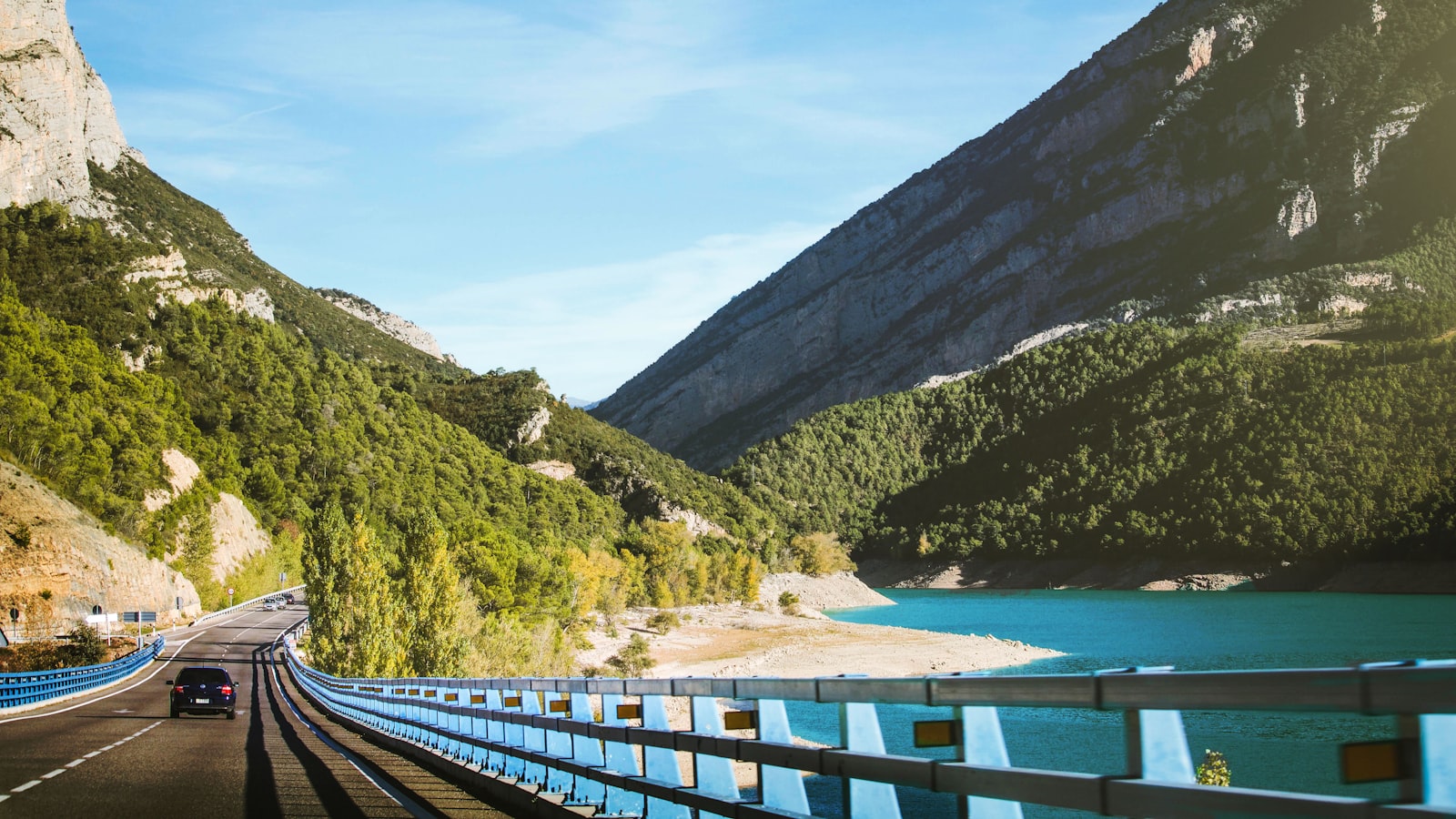
Spain is one of Western Europe's great fuel bargains. Drive down from Germany, France or the UK for the summer and the pump is one of the few things that gets cheaper as you go south. As of 22 July 2026, Spanish petrol averages 1.63 €/L and diesel 1.69 €/L, against an EU-wide average of 1.88 €/L and 1.96 €/L. On diesel alone the gap to France is about 0.44 €/L per litre, and to Germany about 0.45 €/L: on a 55-litre tank, filling in Spain instead of Germany saves roughly 24.64 €.
The table below is computed live from the stations we track, cheapest per fuel in bold. It puts Spain next to its neighbours and a high-tax benchmark:
| Country | Gasoline (€/L) | Diesel (€/L) |
|---|---|---|
| 🇪🇸 Spain | 1.63 | 1.69 |
| 🇵🇹 Portugal | 2.01 | 2.02 |
| 🇫🇷 France | 2.03 | 2.14 |
| 🇮🇹 Italy | 1.99 | 2.15 |
| 🇩🇪 Germany | 2.15 | 2.14 |
Live national averages, cheapest per fuel in bold. Spanish figures come from the official MINETUR price feed.
Why Spain is cheaper: the tax answer
The difference is not the oil, it is the tax. Every country buys crude on the same world market; what they add on top varies enormously. Spain's fuel excise duties are among the lowest in the European Union. Using Tax Foundation figures for 2026, Spain levies about 0.504 euros per litre of excise on petrol and 0.379 on diesel. France charges roughly 0.683 and 0.594, Germany 0.655 and 0.470, Italy 0.713 and 0.632. Spain's diesel duty in particular sits close to the EU legal minimum of 0.330 euros per litre. Before a single station sets a price, Spanish fuel already starts 15 to 20 cents per litre ahead of France or Italy on tax alone.
One point of confusion worth clearing up. During the 2022 energy crisis Spain ran a temporary 20-cent-per-litre discount for all drivers (Royal Decree-law 6/2022). That general subsidy ended at the close of 2022, and in 2023 support was narrowed to professional hauliers, farmers and fishermen. So the "gasóleo profesional" rebate you may read about is not something a tourist can claim, and there is no longer a blanket discount at the pump. Spain is cheap today because of durable, structural tax policy, not a temporary handout.
How to find the very cheapest pumps
Within Spain the spread between stations is large, and it is easy money if you know where to look. The country has a thriving "low-cost" sector: unmanned, automated stations run by chains such as Ballenoil, Plenoil, Petroprix, Gasexpress and bonÀrea. These routinely undercut the big branded networks by 10 to 30 cents per litre. The fuel meets the same legal quality standard as any branded pump. What you give up is the forecourt service and the branded additive package, not the fuel itself, so for a holiday tank the saving is close to free.
Finding them takes seconds. Spain has unusually transparent price data: every station is legally required to report its prices, hourly, to the government portal geoportalgasolineras.es, run by the ministry. Our own live map draws on the same official feed, so you can compare every station on your route before you commit, and the Spain country page shows today's averages and the cheapest stations we track. As a rule of thumb, pull off the motorway and into a town or a retail park: motorway stations charge a steep premium, and the low-cost chains cluster around the edges of towns.
The Canary Islands are cheaper still
If your summer takes you to Tenerife, Gran Canaria or Lanzarote, expect another step down in price. The Canaries have their own tax regime, the Régimen Económico y Fiscal, which exempts fuel from the mainland hydrocarbon excise and applies the local IGIC instead of the 21 percent peninsular VAT. The result is pump prices structurally below even the cheap mainland (Telecinco).
Wherever you drive, the same habit pays: check before you fill. Thirty seconds on the live map is regularly worth a double-digit sum per tank, and developers can pull the same data from our free API.